Hybrid Work vs. Remote Work vs. In-Office
"Choosing between hybrid, remote, and in-office work requires balancing operational capacity with team productivity. This guide compares each model and explains how to implement workplace policies that rely on actual utilization data rather than calendar assumptions. "

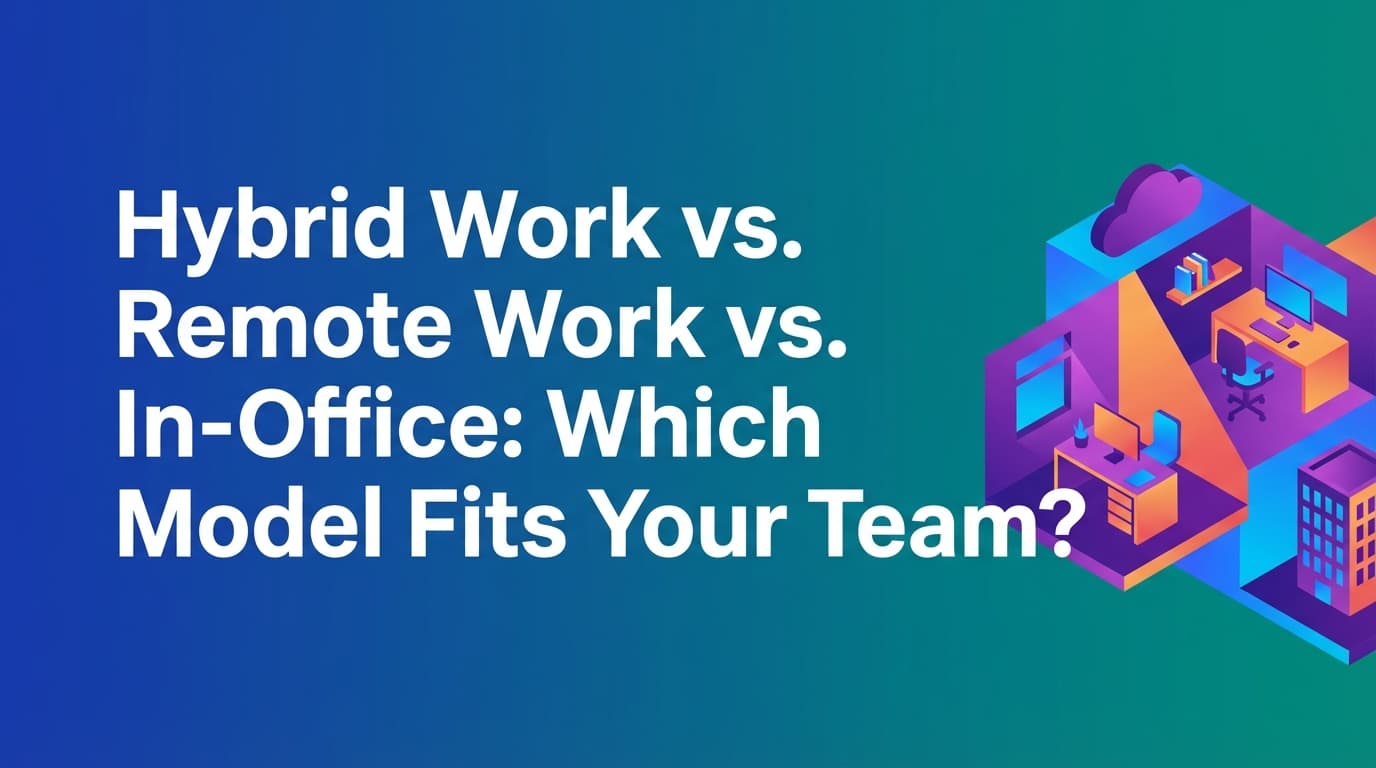
Choosing the right work model—hybrid work, remote, or in-office—depends on how your organization handles workplace operations. While many teams focus on employee preference, the most successful models are built on operational truth. Unlike simple booking tools that rely on calendar invites, a unified workplace system enforces check-ins and tracks real usage. This guide explains how to select a model that fits your team while ensuring your office data remains audit-grade and reliable.
What is the difference between hybrid, remote, and in-office work?
The primary difference between these models is where work happens and how the workplace is managed. In-office work requires a fixed desk for every employee. Remote work eliminates the physical office entirely. Hybrid work is a flexible model where employees split time between home and the office.
Because WOX uses a unified data model, organizations can switch between these models without changing their underlying infrastructure. The system treats a desk, a parking spot, or a lab bench as a resource with specific rules, allowing operations teams to adjust capacity as the work model evolves.
Why do hybrid work policies often fail?
Most hybrid work policies fail because they rely on "ghost bookings." In many offices, employees reserve desks or meeting rooms in a calendar, but never actually show up. When a system assumes a booking equals attendance, the data becomes useless for real estate planning.
Because WOX enforces check-ins, the system knows the difference between a reservation and actual occupancy. If an employee doesn't check in within a specific window, the resource is automatically released. This enforcement ensures that the "hybrid" model doesn't result in a perceived shortage of space when the office is actually half-empty.
Policy failure often stems from a lack of executable rules. If your policy says "three days in office" but your software can't block a fourth booking or report on the missing third day, the policy is just a suggestion. WOX implements these policies as hard rules within the engine, ensuring governance happens at the point of booking, not through manual auditing later.
Where traditional booking tools fall short
Traditional booking tools are often just "skins" on top of Google Calendar or Outlook. They inherit the limitations of those platforms, which were never designed for physical resource management.
- Calendar assumptions: Traditional tools assume that if a meeting is on the calendar, the room is occupied. They lack the logic to handle no-shows or early departures.
- Rigid resource types: Most tools are hardcoded for desks and rooms. They cannot easily model a laboratory station, a specialized piece of equipment, or a locker.
- Manual reporting: Because they don't enforce check-ins, facilities managers have to manually reconcile badge swipes with booking logs to find the "truth."
- Vendor-dependent layouts: Changing an office floor plan often requires calling a vendor to update a CAD file or a proprietary map.
WOX solves these issues through self-service spatial modeling. Operations teams can change layouts, add resources, or adjust capacities directly in the platform without external help. This flexibility is necessary when a team decides to transition from a 1:1 assigned seating model (in-office) to a shared desk model (hybrid).
How do you track real office utilization?
Real utilization is measured by check-ins, not bookings. To get an accurate picture of how your office is used, you need a system that captures every stage of the resource lifecycle: the request, the approval (if needed), the check-in, the actual duration of use, and the release.
When you use a system with multi-modal booking logic, you can track different types of usage simultaneously. For example, some desks might be shared (hot desking), while others are exclusive to a specific department for a week. WOX handles these overlapping rules in one engine. Because the system tracks the actual check-in event, it generates audit-grade data that finance and operations teams can use to make lease decisions.
What are the pros and cons of the in-office model?
The in-office model provides the highest level of predictability for workplace operations. Every person has a designated spot, and resource requirements are static.
Pros:
- Immediate access to specialized equipment and resources.
- Simplified IT and security governance within a controlled environment.
- Predictable facility costs (utilities, cleaning, maintenance).
Cons:
- High real estate overhead, especially if desks sit empty during travel or illness.
- Limited flexibility for employees, which can impact retention.
- Inability to scale the headcount without physically expanding the office.
In an in-office model, WOX acts as the system of record for assets. Even if desks aren't "booked," the system manages the lifecycle of the space, ensuring that visitor management and room scheduling are tied to the same unified policy engine used for employee access.
What are the pros and cons of the remote work model?
Remote work removes the physical office as a requirement for daily operations. This model relies heavily on digital infrastructure rather than physical space.
Pros:
- Significant reduction in real estate and facility maintenance costs.
- Access to a global talent pool regardless of geography.
- Elimination of commute-related stress for employees.
Cons:
- Loss of "operational truth" regarding how and when people collaborate.
- Increased complexity in managing hardware and physical assets sent to homes.
- Potential for silos to form between teams.
For remote-first companies, workplace operations usually shift toward managing occasional gatherings or "offsite" spaces. Because WOX is resource-agnostic, it can model these external spaces just as easily as an internal office, allowing remote teams to book regional hubs or co-working spaces under the same corporate governance and SCIM-based access controls.
What are the pros and cons of the hybrid work model?
The hybrid model is the most complex to manage because it involves fluctuating demand. It requires a sophisticated operational system to ensure that the office doesn't become a source of friction.
Pros:
- Optimized real estate costs through desk sharing and neighborhood-based seating.
- Increased employee satisfaction by offering autonomy.
- Ability to support more employees than the physical desk count allows.
Cons:
- Requires active management of "peak days" (usually Tuesday–Thursday).
- Risk of "ghost bookings" making the office feel full when it isn't.
- Need for reliable calendar sync to prevent double-bookings across time zones.
Hybrid success depends on reliable calendar sync. WOX handles recurrence, edits, and cancellations at scale, ensuring that if an employee changes their "office day" in their personal calendar, the desk resource is updated instantly across the entire system. This prevents the coordination tax that often kills hybrid productivity.
How to model complex office resources for your team
Most offices are more than just desks and rooms. They include parking spots, phone booths, monitors, height-adjustable desks, and even lab equipment. If your workplace tool can't model these, you end up with fragmented data.
Because WOX is resource-agnostic, anything with availability and capacity can be modeled. An operations manager can create a "Resource Type" for a 3D printer or a specific parking zone. You can then apply multi-modal logic: perhaps the 3D printer is booked in 2-hour slots, while the parking spot is a full-day booking.
This level of detail allows the system to enforce specific policies. For example, you might restrict parking bookings to only those who have also checked into a desk for that day. This cross-resource logic is only possible when all activities live in one unified operational system.
Implementing enterprise governance without friction
As teams grow, managing who can book what—and where—becomes a significant burden for IT and HR. Manual spreadsheets or basic apps can't handle the complexity of global permissions.
WOX integrates enterprise governance into the core of the platform. By using SCIM (System for Cross-domain Identity Management), employee roles and locations are synced automatically from your identity provider (like Okta or Azure AD).
When a team member moves from the London office to the New York office, their booking permissions update instantly. They lose access to London desks and gain access to New York resources based on the policies defined for that location. This happens without a workplace manager having to manually edit a single user profile. Role-based controls ensure that sensitive areas, like executive suites or secure labs, are only bookable by authorized personnel, and these rules are enforced at the point of interaction.
Which model fits your team?
To decide which model fits, look at your operational data rather than just sentiment surveys.
- Analyze current utilization: If your office has 100 desks but only 30 are used on average, a hybrid model with shared seating is the logical choice.
- Assess resource dependency: If your team requires specialized hardware or high-security environments, an in-office or "office-first" hybrid model is necessary.
- Evaluate geographic distribution: If your talent is spread across time zones, a remote-first model supported by occasional hub bookings might be best.
- Test policy enforcement: Can your current system handle a "3 days per week" rule? If not, you may need to upgrade your workplace infrastructure before committing to a hybrid model.
The goal is to move away from "managing by feeling" and toward "managing by data." When you have a system that provides a single version of the truth, the choice of work model becomes a strategic decision based on facts.
Next steps for workplace operations leaders
The transition between work models is rarely a one-time event. It is an ongoing process of adjustment. To start, audit your current booking data. Look specifically for the gap between "reservations" and "check-ins." This gap represents your wasted capacity and the primary area where improved operational enforcement can save costs.
Once you have identified the gap, consider how a unified policy engine could automate the enforcement of your chosen model. Whether you are moving toward a dense hybrid setup or maintaining a traditional office, the infrastructure you use to manage those resources will determine your success.
Learn more about Hybrid Work Guide
For comprehensive guidance, see our guide on hybrid work strategies and implementation.
Related Articles
Explore more insights on this topic:
Want to learn more about Hybrid Work?
Explore our complete guide with more articles like this one.